How to Check an Estonian Company: A Practical Guide
Estonia is one of the easiest countries in Europe in which to check a company. Most of the core data is public, online, and available at little or no cost, which means you can build a solid picture of a potential partner, supplier, or client in a few minutes. The trick is knowing which sources to use and how to read what you find. Here is a practical walkthrough.
Start With the Registry Code
Every Estonian company has an eight-digit registry code (registrikood). It is the most reliable way to identify a company, because names can be similar or change over time while the code does not. If you only have a name, you can search for it, but confirm you have the right entity by matching the registry code before drawing any conclusions. The official source is the e-Business Register at ariregister.rik.ee, which has an English-language interface.
Check Who Runs and Owns the Company
Start with the people. The register shows the management board members (the individuals who can legally represent the company), the shareholders, and the founders. Look at how long the current board has been in place and whether ownership is concentrated or spread out. If the same individual appears behind many short-lived companies, that is worth a closer look. These details tell you who you are actually dealing with, beyond the company name.
Read the Financial Reports
Estonian companies file annual reports (majandusaasta aruanne) with the Business Register, and these are generally public. They show revenue, profit, equity, assets, and employee numbers. Look at the trend across several years rather than a single figure: steady or growing revenue tells a different story than a sharp decline. Negative equity is a warning sign worth noting. Keep in mind that reports are backward-looking and reach the register months after the year ends.
Check Tax Data and Tax Debt
The Estonian Tax and Customs Board (MTA) publishes quarterly figures for paid taxes, turnover, and employee counts, along with any tax debt. Tax debt above a small threshold is public. Weigh the debt against the company's size, check how old it is, and note whether a payment plan is in place, which signals the company is addressing it. Paid taxes and employee numbers also confirm whether the company is genuinely active.
Verify the VAT Number
If the company is VAT-registered, you can confirm its VAT number through the EU's VIES system, which validates VAT numbers across member states. This is useful before issuing cross-border invoices or claiming intra-EU supply rules.
Understand Beneficial Ownership and Its Limits
Estonian companies are required to declare their beneficial owners, the individuals who ultimately own or control the company. However, following a 2022 EU Court of Justice ruling, general public access to this specific data was restricted, and as of 2026 it is available to authorities, regulated businesses, and parties with a legitimate interest such as journalists. So while board members and shareholders are public, the beneficial ownership layer is now more restricted.
See Everything in One Place
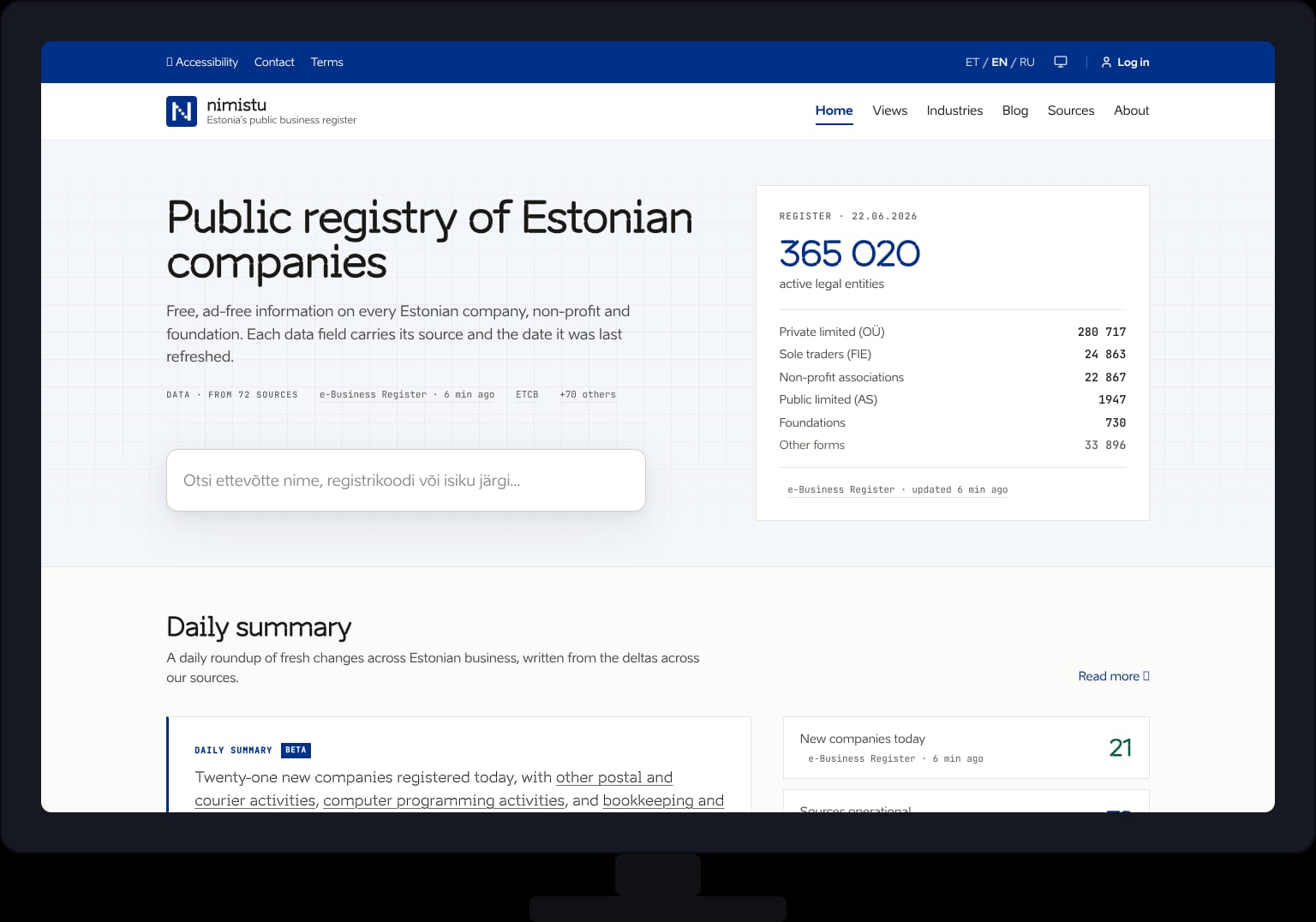
Because this data is spread across the Business Register, the Tax Board, and other sources, pulling it together by hand is tedious. Aggregators collect it onto a single profile. Nimistu is one free, ad-free option that shows each fact with its source and date, so you can see where a figure came from. Commercial services such as Inforegister, Teatmik, and e-Krediidiinfo offer similar overviews with added scores and analysis.
What a Company Check Won’t Tell You
Public data shows facts, not intentions. A clean record does not guarantee a good partner, and a brand-new company is not automatically a risk. For larger deals, treat the public data as a starting point and combine it with references, clear contract terms, and, where appropriate, payment safeguards.